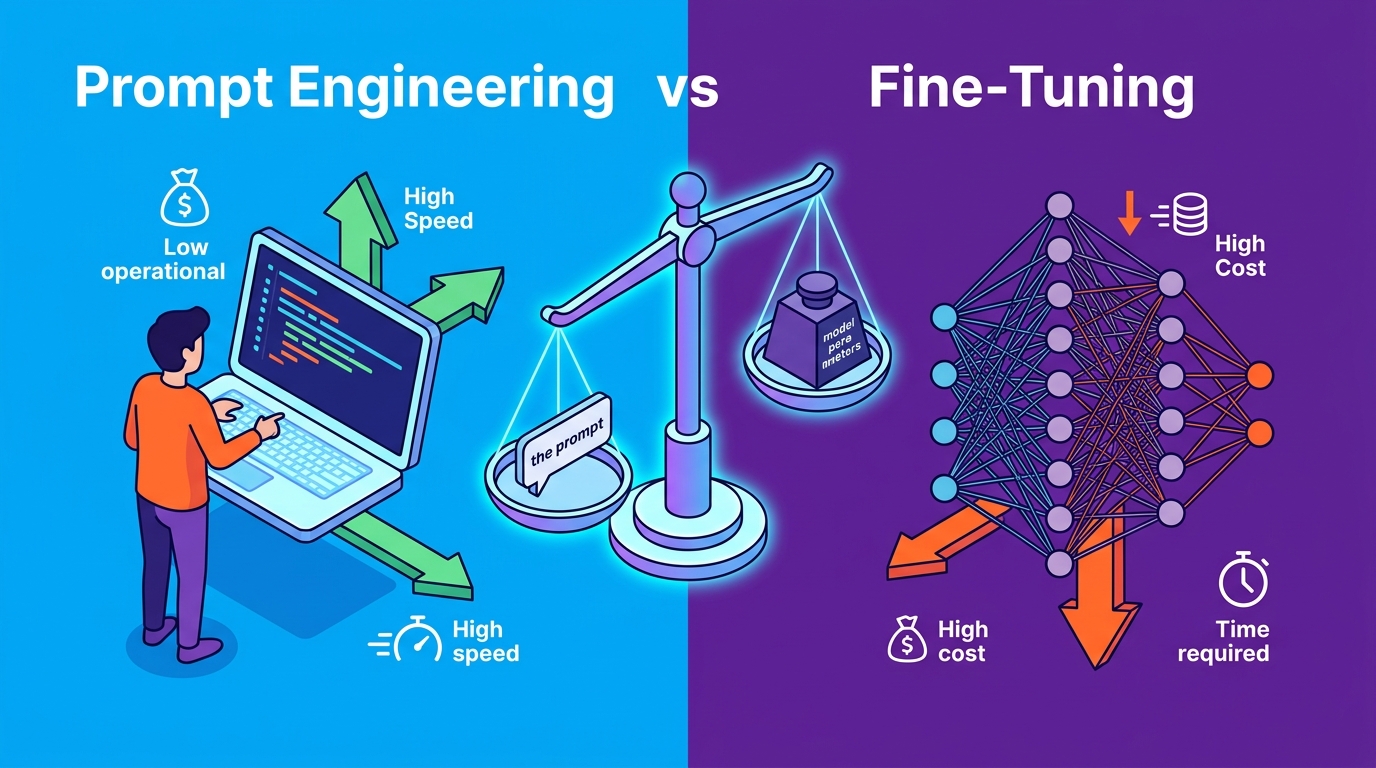
Fine-Tuning vs. Prompt Engineering: A Decision Framework for Backend Engineers
You've shipped a RAG pipeline. Your prompts are reasonably tuned. But accuracy on edge cases is frustrating you, and a teammate just suggested fine-tuning. Before you commit to that path, it's worth asking a harder question: have you actually exhausted what prompt engineering can do, or does fine-tuning just feel like the more serious engineering solution?
This post gives you a decision framework grounded in operational reality — not capability benchmarks from a research paper.
The Default Should Be Prompt Engineering
The engineering instinct to reach for fine-tuning often comes from a reasonable place: the model isn't behaving consistently, outputs don't match your domain's tone or format, and more prompting feels like duct tape. But that instinct misreads what prompt engineering is actually capable of at its ceiling.
In-context learning is surprisingly powerful. A well-structured prompt with 5–10 few-shot examples can shift model behavior substantially — adjusting output format, enforcing domain vocabulary, constraining reasoning style. Most teams hit a prompt engineering plateau not because the technique ran out of headroom, but because the prompts themselves were never systematically iterated.
Before treating fine-tuning as the next logical step, you should have:
- Tested structured few-shot prompting with representative examples drawn from your actual failure cases
- Measured a baseline — a concrete accuracy or quality metric, not a vibe assessment
- Tried system prompt hardening — explicit negative constraints, output schemas, chain-of-thought instructions
- Evaluated a larger base model — sometimes GPT-4o solves what GPT-4o-mini struggled with, at a fraction of the engineering cost of fine-tuning
If you haven't done all four, fine-tuning is premature.
# A few-shot prompt structure that often eliminates the perceived need for fine-tuning

SYSTEM_PROMPT = """
You are a support ticket classifier for a B2B SaaS product.
Always respond with a JSON object: {"category": str, "priority": "low"|"medium"|"high", "confidence": float}
Do not include explanation. Do not add fields.

Examples:
Input: "Invoice PDF won't download"
Output: {"category": "billing", "priority": "medium", "confidence": 0.91}

Input: "API returning 500 on /v2/events since 2pm UTC"
Output: {"category": "api_reliability", "priority": "high", "confidence": 0.97}
"""

# Measure this against your labeled test set before concluding it's insufficient.
# If F1 > 0.85 on your eval set, fine-tuning will not move the needle enough to justify the cost.
When Fine-Tuning Is Actually Justified
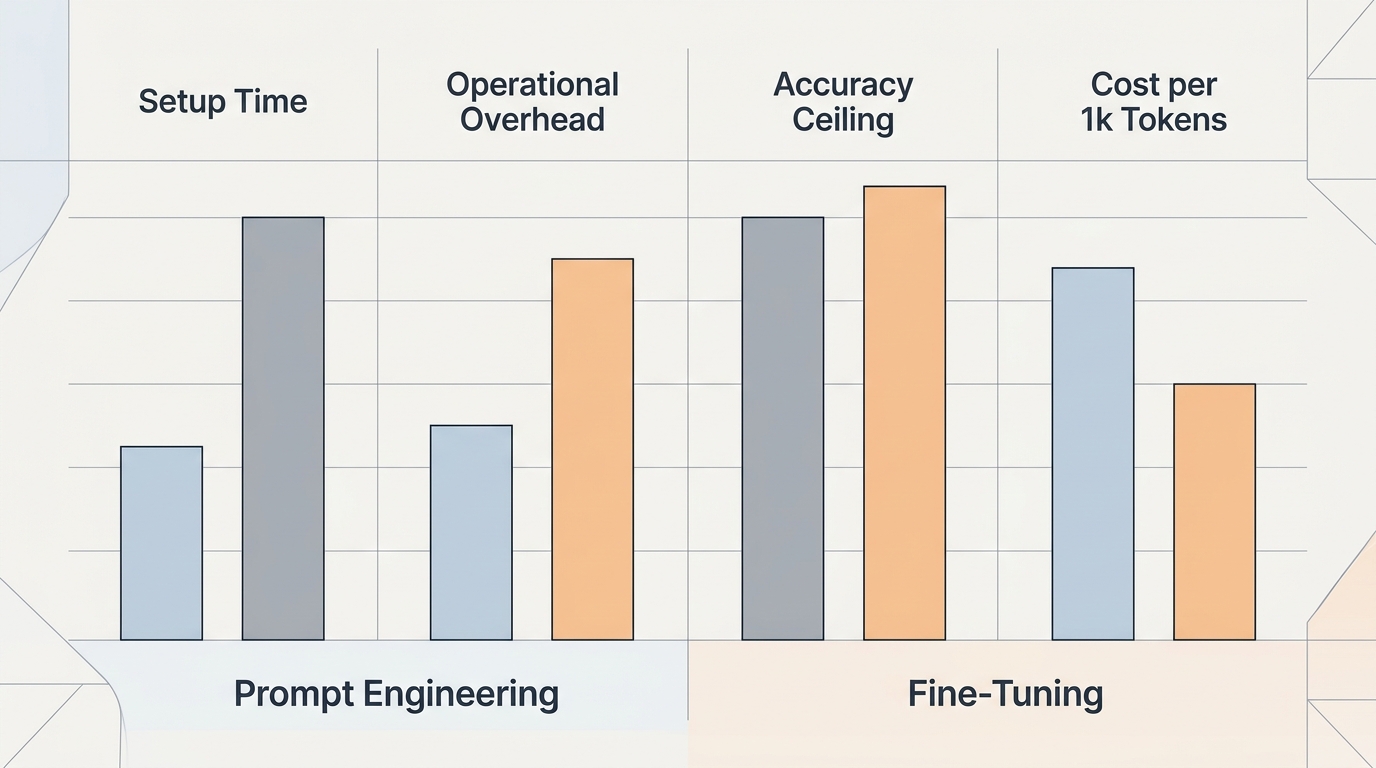
Fine-tuning earns its complexity under three specific conditions. These are and conditions, not or conditions — the more of them that apply, the stronger the case.
1. You have a consistent, labeled dataset of 500+ examples. Not 500 examples you could label. Five hundred examples that are already labeled, quality-reviewed, and representative of the distribution your model will face in production. Below this threshold, few-shot prompting with a strong base model will likely match or exceed fine-tuned performance.
2. Latency or cost constraints require a smaller model. If your use case demands sub-300ms inference or you're processing millions of requests per day, running GPT-4-class models becomes economically unsustainable. Fine-tuning a smaller model — GPT-4o-mini, Llama 3.1 8B, Mistral 7B — on your specific task can reach acceptable quality at a fraction of the per-token cost. This is the strongest practical argument for fine-tuning in production systems.
3. Prompt engineering has measurably plateaued. You have an eval suite. You've iterated prompts systematically. Your F1 (or whatever metric matches your task) has been stuck below your quality threshold for multiple iterations. This is a plateau — not a single bad run.
What does a minimal fine-tuning eval setup look like?
Before committing to fine-tuning, you need a repeatable eval harness. At minimum:
import openai
from sklearn.metrics import f1_score

def evaluate_classifier(model: str, test_cases: list[dict]) -> float:
    predictions = []
    labels = []

    for case in test_cases:
        response = openai.chat.completions.create(
            model=model,
            messages=[
                {"role": "system", "content": SYSTEM_PROMPT},
                {"role": "user", "content": case["input"]}
            ]
        )
        predicted = parse_category(response.choices[0].message.content)
        predictions.append(predicted)
        labels.append(case["expected_category"])

    return f1_score(labels, predictions, average="weighted")

# Run this against base model before fine-tuning.
# Run it again after. The delta needs to justify your operational overhead.
baseline_f1 = evaluate_classifier("gpt-4o-mini", test_cases)
print(f"Baseline F1: {baseline_f1:.3f}")
If the delta post-fine-tuning is less than 5–8 percentage points, the return rarely justifies the investment for most production systems.
The Operational Cost Engineers Underestimate
Fine-tuning is not a one-time training run. It is an ongoing operational commitment that includes:
- A data pipeline — collecting, labeling, versioning, and deduplicating training examples as your product evolves
- Model versioning and rollback — your fine-tuned model is a deployable artifact that needs the same promotion and rollback discipline as your application code
- Drift monitoring — as the base model provider releases updates, your fine-tuned adapter may degrade silently; you are now maintaining a fork
- Re-training cadence — production distributions shift; a model trained on last quarter's data may underperform on this quarter's inputs
This is not a reason to never fine-tune. It is a reason to treat the decision with the same rigor you'd apply to adopting a new stateful infrastructure dependency.

The Decision Checklist
| Condition | Recommendation |
|---|---|
| No labeled eval set yet | Start with prompt engineering; build evals first |
| Fewer than 500 labeled examples | Few-shot prompting; collect more data in parallel |
| Prompt F1 > 0.85 on your eval set | Ship it; fine-tuning won't move the needle enough |
| Hard latency SLA < 300ms | Evaluate smaller base models first, then fine-tune |
| Cost at scale is unsustainable | Fine-tuning a smaller model is justified |
| Prompt engineering plateau confirmed | Fine-tuning is warranted; plan for operational overhead |
The Takeaway
Fine-tuning is not a performance upgrade — it is an infrastructure decision. Treat it like one: measure your prompt engineering ceiling first, confirm you have the data and operational maturity to maintain a model fork, and only invest when the accuracy or cost delta is large enough to justify a new deployment dependency.
The engineers who get the most out of fine-tuning are the ones who almost talked themselves out of it — because they did the measurement work first.