Debugging RAG Quality Degradation: A Production Troubleshooting Framework
Your RAG pipeline passed all your tests. It worked well in staging. You shipped it, got good early feedback — and then, three weeks later, users started complaining that answers were vague, off-topic, or just wrong.
You check the logs. No errors. The vector DB is responding. The LLM is generating text. Everything looks operational.
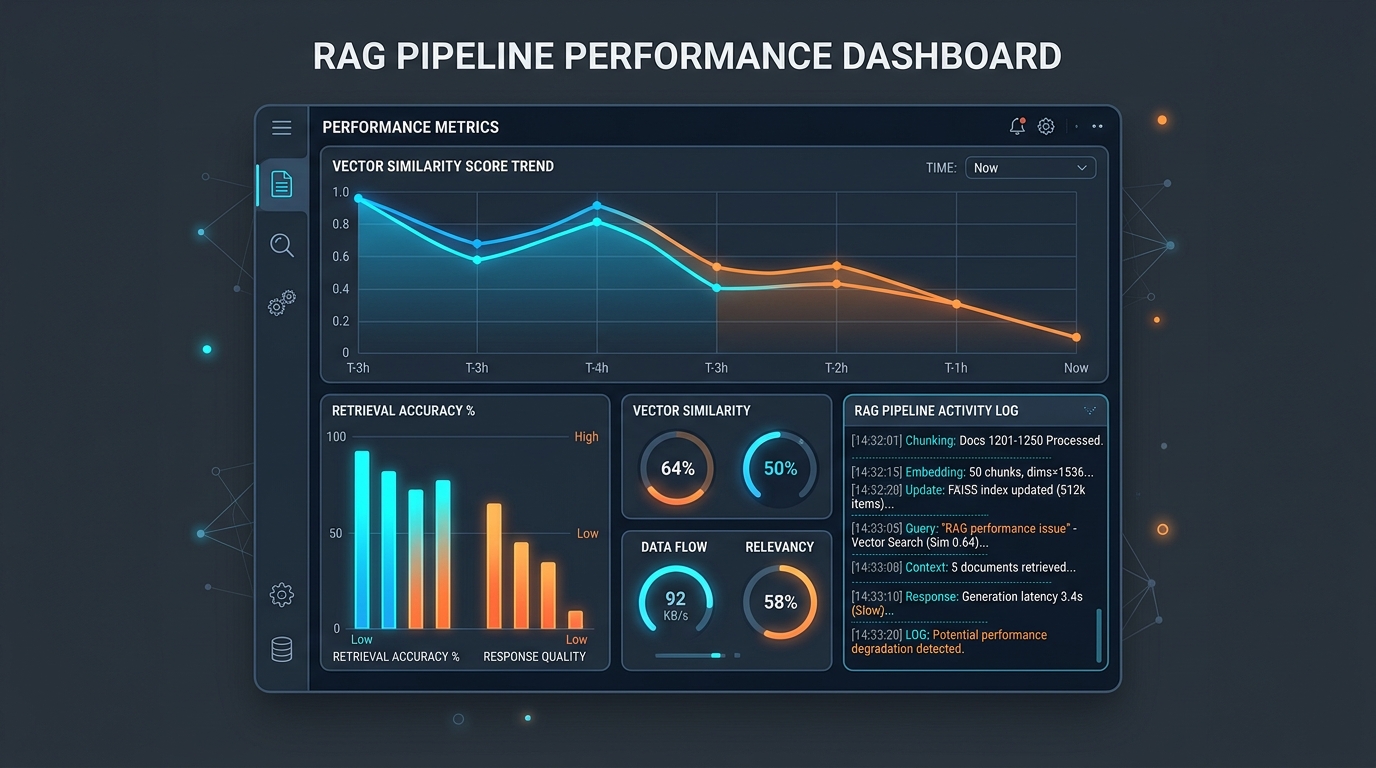
This is the defining failure mode of RAG systems in production: relevance degrades silently, without throwing exceptions or triggering alerts. Unlike a broken API endpoint, a RAG system that returns bad answers looks exactly like one that returns good ones — unless you've instrumented for quality, not just availability.
The Three Root Causes of RAG Degradation
Before you can fix the problem, you need to understand which failure mode you're dealing with. There are three distinct categories.
1. Embedding Drift
This happens when the vector representations of your data no longer align with the vector representations of incoming queries. Common triggers:
- You updated your embedding model (even a minor version bump can shift the vector space)
- Your document corpus changed significantly — new terminology, new product names, new domain language
- Your users' query patterns shifted (e.g., they started asking procedural questions when your index was built for factual lookups)
The symptom: retrieval scores that used to average 0.82 are now averaging 0.61, even on queries that haven't changed.
2. Retrieval Ranking Collapse
The embeddings are fine, but the ranking logic is broken. This surfaces when:
- A reranker model was updated or swapped without re-validation
- Vector index parameters changed (HNSW
ef_search,nprobein IVF indexes) - A metadata filter was added that's silently excluding relevant chunks
The symptom: the right document is in your index, but it's not appearing in the top-k results.
3. Context Mismatch
This is the most insidious failure. Retrieval scores look healthy. The top chunks look topically relevant. But the LLM still can't answer the question — because the chunks contain related content, not answering content.
A chunk about "password reset policy" scores highly for "how do I reset my password" but contains only the policy statement, not the actual steps. High cosine similarity, zero utility.
Instrumenting Your Pipeline for Debugging
The fix starts with visibility. Here's a minimal instrumentation wrapper that captures what you need for a post-mortem:
import time
import logging
from dataclasses import dataclass, field
from typing import Any

@dataclass
class RetrievalTrace:
    query: str
    top_chunks: list[dict] = field(default_factory=list)
    scores: list[float] = field(default_factory=list)
    latency_ms: float = 0.0
    embedding_norm: float = 0.0

def instrumented_retrieve(query: str, retriever, embed_fn, top_k: int = 5) -> RetrievalTrace:
    trace = RetrievalTrace(query=query)

    start = time.monotonic()

    # Capture the query embedding and its norm
    query_embedding = embed_fn(query)
    trace.embedding_norm = float(sum(x**2 for x in query_embedding) ** 0.5)

    # Run retrieval
    results = retriever.query(
        query_embedding=query_embedding,
        top_k=top_k,
        include_metadata=True
    )

    trace.latency_ms = (time.monotonic() - start) * 1000
    trace.scores = [r["score"] for r in results]
    trace.top_chunks = [
        {"id": r["id"], "text": r["text"][:200], "score": r["score"]}
        for r in results
    ]

    # Log for post-mortem analysis
    logging.info("rag_retrieval", extra={
        "query": query,
        "top_score": trace.scores[0] if trace.scores else None,
        "avg_score": sum(trace.scores) / len(trace.scores) if trace.scores else None,
        "embedding_norm": trace.embedding_norm,
        "chunk_ids": [c["id"] for c in trace.top_chunks],
        "latency_ms": trace.latency_ms
    })

    return trace
With this in place, you can aggregate avg_score over time and alert when it drops below a threshold. You can also detect embedding drift by monitoring embedding_norm — a sudden shift in norm distribution across queries is a strong signal that your embedding model changed behavior.
The Debugging Checklist
When quality degrades, run through this in order:
- Check score trends — Pull average retrieval scores over the last 7 days. Sudden drop points to embedding drift or index issues. Gradual drop suggests corpus/query drift.
- Re-embed a fixed query set — Take 10 queries you know worked before, re-run embeddings today, compare cosine similarity to their stored embeddings. Similarity below 0.98 means your model changed.
- Inspect the top chunks manually — For 5 failing queries, look at what chunks were retrieved. Are they topically related but not answering? That's context mismatch — a chunking or reranking problem, not an embedding problem.
- Check metadata filters — Audit any filters applied at query time. A date filter, tenant filter, or tag filter silently excluding documents is a common culprit.
- Validate your reranker — If you use a cross-encoder reranker, test it in isolation. Pass it known-relevant pairs and verify scores are still sensible.
How to detect embedding model version changes automatically
If you're using a hosted embedding API (OpenAI, Cohere, Voyage), the model version can change under you. Store the model identifier alongside each embedded document at index time:
# When indexing
metadata = {
    "chunk_id": chunk_id,
    "embedding_model": "text-embedding-3-small",  # store this
    "indexed_at": datetime.utcnow().isoformat()
}
At query time, assert that the query embedding model matches the index embedding model. If they diverge, you need to re-index — mixing embedding models in the same vector space produces garbage retrieval.
The Takeaway
RAG systems don't crash when they stop working — they silently return confident-sounding wrong answers. The only way to catch degradation before users do is to treat retrieval score, embedding norm, and chunk content as first-class observability signals, not afterthoughts.
Log retrieval scores and chunk text on every query. Everything else in this framework depends on that data existing when you need it.